

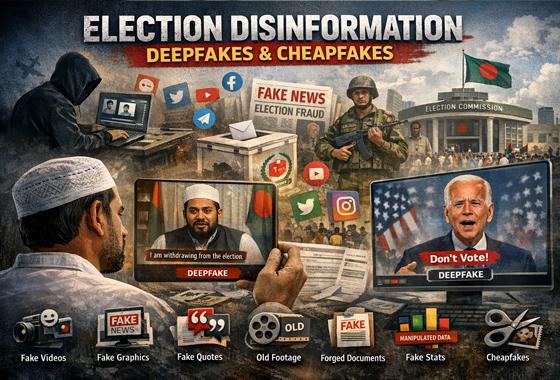
The results of the 12th parliamentary elections in Bangladesh held on January 7, 2024 were predictable. However, an incident involving the use of deepfake around that election has come into the spotlight again. On the morning of the voting day, a fake video of Abdullah Nahid Nigar, an independent candidate for Gaibandha-1 constituency, went viral on social media. There, he was seen announcing his withdrawal from the election. Although it was later proven to be a deepfake, many voters were confused by then.
This is just one real example of electoral deepfake in Bangladesh. According to a 2024 report by the German organization Konrad Adenauer Foundation (KAS), the use of deepfake and disinformation has increased in recent elections in many countries, including the United States, India, Turkey, Slovakia, Argentina, Indonesia, Poland, Bulgaria, Taiwan, and France.
What are deepfake and chipfake
A deepfake is a fake video, audio, or image created using artificial intelligence that looks exactly like the real thing. Chipfake, on the other hand, is created not with AI, but with relatively cheap software—where true content is distorted or misrepresented. For example, spreading false statements by copying media photocards.
10 main disinformation tactics used in the country
According to fact-checkers and law enforcement agencies, the most commonly used tactics in elections in the country are—
- Adding misleading captions to true videos or photos
- Cut out parts of speeches and change the context
- Making fabricated statements or quotes in the name of a specific person
- Presenting old videos or photos as new events
- Using the voice and face of a candidate in a deepfake video
- Fake graphics from media photocards or TV scrolls
- Using fake statistics and numbers
- Faking screenshots and documents
- Spreading the same false information from multiple pages and accounts at once
- Coordinated propaganda using fake Facebook pages and bot armies
Video is now the biggest weapon
According to an analysis by fact-checking organization DismissLab, 66 percent of the fake information spread between July and September 2025 was video-based. The use of text and images has decreased compared to the previous three months. In other words, as the election approaches, the video-based confusion created by AI is also increasing.
According to Rumor Scanner, 1,441 false information was detected in the three months from October to December last year. Of these, 956 were political. Video-based disinformation accounted for the most—651.
Who is doing this disinformation
Analysts say that two main groups are working behind the disinformation.
One group is politically or ideologically motivated.
The other group creates and spreads disinformation in exchange for money.
According to Miraj Ahmed Chowdhury, Managing Director of Digitally Right, although it is easy to identify accounts spreading disinformation, an investigation is needed to find the organizers behind it, which is not possible for fact-checkers. According to him, Facebook pages opened under fake identities and 'bot armies' are working in favor of political forces.
Law enforcement sources said that leaders and activists of the banned Awami League are also spreading disinformation in an organized manner by creating groups on various platforms including Telegram.
What is the government doing
The National Cyber Security Agency has formed a special cell to deal with the risk of disinformation. Work is underway in coordination with the Election Commission, Press Wing, PIB, BSS, BTRC and law enforcement agencies. The Cyber Police Center of the Police CID has announced 24-hour surveillance.
But why is the risk not decreasing
According to experts, the problem is that disinformation spreads very quickly, but it takes time to verify and remove it. In the meantime, people assume it to be true. Even political leaders and some media outlets are spreading fake content on social media without verification.
Professor BM Mainul Hossain, Director of the Institute of Information Technology, Dhaka University, warned that there are examples of elections being postponed in various countries due to deepfakes and cyber attacks. Although the risk has been acknowledged in Bangladesh as well, effective prevention is still not enough.
Leave a comment
Your email address will not be published. Required fields are marked *